PQWT PQ225E Underground Water Aquifer Survey 400/600/800/1000M
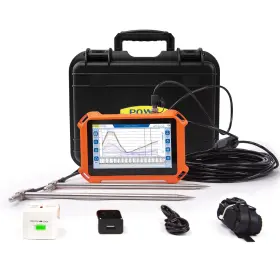
( Brand: Pqwt ), ( Manufacturer Part Number: PQ225E ), ( Part Type: Water ), ( Battery Installation Device Type: Installed In Vehicle ), ( Sensor Technology: Geophysical Sensor ), ( Color: Pq225e-1000m ), ( Battery Weight: 85.0 ), ( Maximum Range: 1000.0 ), ( Contains Battery Or Cell: Battery ), ( Batteries Required : Yes ), ( Power Source Type: Battery Powered ), ( Compatible Devices: Computer, Sd Card Reader ), ( Material: Plastic ), ( Unit Count: 1.0 ), ( Package Dimensions Lxwxh: 15.75x13.58x6.41 Inches ), ( Weight: 10.15 Pounds )
Review PQWT Underground Water For Well 400/600/800/1000m Aquifer Survey
The PQWT PQ225E is a high-performance, versatile groundwater exploration system designed for surveying aquifers at depths ranging from 400 to 1000 meters. This system is ideal for geologists, hydrogeologists, and environmental consultants seeking accurate and reliable data for groundwater exploration and resource assessment.
The PQWT PQ225E features a robust and compact design, with a slim diameter borehole probe that minimizes drilling requirements and reduces environmental impact. The system consists of a water well logging tool, a data logger, and a user-friendly software package for data analysis.
The water well logging tool incorporates several advanced sensors to measure various geophysical properties of the aquifer, including resistivity, self-potential, temperature, and neutron density. These sensors provide valuable information about the geological structure, hydrological conditions, and contamination levels of the aquifer.
The resistivity sensor measures the electrical conductivity of the water and the surrounding geological formations. This data can be used to identify the presence and location of aquifers, as well as to determine their thickness and productivity. The self-potential sensor measures the natural electrical potential of the aquifer, which can provide information about the redox conditions and the presence of mineralized zones.
The temperature sensor measures the temperature of the water, which can help identify thermal anomalies and hydrogeological features. The neutron density sensor measures the hydrogen index of the water, which can be used to estimate the total porosity and water saturation of the aquifer.
The data logger records and stores the data collected by the sensors in real-time, allowing for immediate analysis and interpretation. The logger also includes a GPS module for precise location tracking and a telemetry system for remote data transfer.
The user-friendly software package provides powerful tools for data analysis and interpretation, including 2D and 3D visualization, inversion algorithms, and statistical analysis. The software can also be used to generate cross-sectional profiles, contour maps, and other visual representations of the data.
The PQWT PQ225E is a reliable and efficient system for groundwater exploration and aquifer survey, offering accurate and detailed data for hydrogeological assessments, contamination studies, and resource evaluation. Its advanced sensors, user-friendly software, and robust design make it an essential tool for geoscientists and environmental consultants working in the field.
Underground water surveys using equipment like the PQWT PQ225e are crucial for assessing the water table depth and quality of aquifers. When considering purchasing this equipment for 400, 600, 800, or 1000m surveys, it is essential to weigh the pros and cons to make an informed decision.
Pros:1. High Accuracy: The PQWT PQ225e uses electrical resistance tomography (ERT) technology, providing high-resolution images of the subsurface, making it an excellent tool for detailed aquifer studies.
2. Versatile: The equipment can be used for various applications, including water table depth mapping, contamination surveys, and hydrogeological studies.
3. Efficient: The system offers fast data acquisition, reducing the time and resources required for surveys.
4. Durable: The PQWT PQ225e is built for harsh environments, ensuring long-lasting performance in the field.
Cons:1. Cost: The price of the PQWT PQ225e is relatively high, especially for larger survey areas (800m and 1000m).
2. Complexity: The equipment requires specialized knowledge and training for operation and data interpretation.
3. Power Consumption: The PQWT PQ225e has a high power consumption, which might necessitate the use of large generators during prolonged surveys.
Conclusion:The PQWT PQ225e is an advanced and powerful tool for underground water surveys, offering high accuracy, versatility, and efficiency. However, its high cost and complexity may be a barrier for some users. Before making a purchase decision, it is essential to consider the specific requirements of your project, the available budget, and the expertise of your team. If the benefits of the PQWT PQ225e outweigh the costs and your team has the necessary skills, it may be the best choice for your underground water survey needs.
Recommendation:If you have a limited budget or require a simpler solution for smaller survey areas, consider alternative methods like manual auger drilling, piezometers, or electrical resistivity tomography (ERT) using smaller equipment. However, for larger, more detailed surveys, the PQWT PQ225e's advanced capabilities and high-resolution imaging make it an excellent investment for understanding the complexities of underground water systems.
Details:
PQ225A offers delectable depths of 50/100/200M, PQ225B 100/200/400M, PQ225C 100/200/400/600M, PQ225D 200/400/600/800M, and PQ225E 400/600/800/1000M, adapting to various groundwater exploration needs. As a direct manufacturer since 2006 specializing in groundwater exploration, PQWT brings extensive experience from tenders, exhibitions, and dealer collaborations worldwide. Real-time curve mutations indicate geological changes for instant aquifer identification. 12 Languages Lifetime Support.Interface supports languages: English, Turkish, Italian, French, Spanish, Arabic, Russian, Korean, German, Portuguese, Polish, and Vietnamese.
Operators obtain on-site results showing aquifer position and depth clearly. Exploration Scan Mode quickly screens large areas to identify potential aquifer zones, reducing ineffective work. Dual Measurement Modes.Features two complementary modes for efficient water finding. Full-Range Precision Mode conducts detailed analysis of abnormal regions, comparing shallow and deep profiles to pinpoint vertical water channels or aquifer structures beneath the surface.
Dual measurement modes Exploration Scan for rapid area screening and Full-Range Precision detailed analysis enable efficient targeting of vertical water channels deep aquifers. Precision Engineering Since 2006 .Equipped with a 32-bit high-speed controller and 16-bit 3.6 MSPS A/D converter, this water detector accurately captures natural electromagnetic field components for clean, reliable data. One automatic mapping delivers on-site results without computer post-processing, significantly shortening exploration cycles.
part #: pq225e price
- $1759.00
specifications secimotions:
- brand: Pqwt
- mpn: Pq225e
- part type: Water
- battery installation device type: Installed In Vehicle
- sensor technology: Geophysical Sensor
- color: Pq225e-1000m
- battery weight: 85.0
- maximum range: 1000.0
- contains battery or cell: Battery
- batteries required : Yes
- power source type: Battery Powered
- compatible devices: Computer, Sd Card Reader
- material: Plastic
- unit count: 1.0
- package dimensions lxwxh: 15.75x13.58x6.41 Inches
- weight: 10.15 Pounds
returns secimotions:
- policy: Returns Accepted
- paid by: Seller
- time: 30 Days
- method: Money back
payments secimotions:
- credit card: Discover
- wallet: Apple-pay
- other
offer secimotions:
- sold: 0
- options: Ship-to-home
- availability: In Stock
- started: June 10, 2026
- quantity: 1
seller secimotions:
- rating: 98.0%
- # reviews: 48
- city: Phoenix, AZ
general secimotions:
- condition: Open box
- Surveillance Smart Home Electronics > Home Surveillance > Sensors Motion Detectors
shipping secimotions:
- carrier: UPS
- cost: $0.00
- type: Fixed
- class: Standard
- transit: 2-5 Days
- service: UPS Ground
Pqwt PQ225E Is Similar To:
- Pqwt Pqwt-cl200 Electronic Testing Equipment For 2m Underground Pipe Locator Water Leakdetection (37.1% similar) Dual-mode detection the instrument contains 2 detection modes, rough measurement mode and filtering analysis mode, helps find the leakage quickly. Electronic testing equipment for 2m underground pipe locator water leakage detection,: color black, brand Pqwt, product dimensions 7.48 l x 19.69 w...(May 24th, 2025)
- Pqwt 912839749897 Pqwt-tc500 Ground Water Detector 500m Depth Deep (45.3% similar) Pqwt-Tc use the natural electric field as electromagnetic work source, based on resistivity differences of underground rock, mineral or groundwater, measure in soil n different components frequency. PQWT-TC500 ground water detector 500M depth deep for well drilling kit...(June 29th, 2025)
- Pqwt 782910972201 L2000 Plumber Tool Pipe Water Leak Detector 5m Different Pipeline Outdoor (34.6% similar) Scope of application apply to property management company, water supply heating companies, fire company pipes leak detection,applicable all kinds pipeline material and ground. YouTube link: S://YOUTH.BE/9 Armagnac, guide for after-sale service - 2-YEAR guarantee-if using of the product is...(September 25th, 2025)
- Pqwt Pqwt-l50 L50 Underground Water Leak Detectors For Home Wall Pipe Detector (52.3% similar) Warranty and languages the main unit comes with a two-year warranty lifetime maintenance.available in 10 languages:English, Turkish,Italian,french,Spanish,Arabic,Russian,Korean,German,Portuguese. It is suitable for water leakage detection of outdoor pipe, fire heating system, indoor and...(September 27th, 2025)
- Pqwt Pq-125b Underground Water Leak Detectors Pq125b Outdoor Wall Pipe Leakage Earphone (49.4% similar) It can also detect silent leaks by pressurizing pipelines. Offering high sensitivity to minor vibrations. Please retain your receipt for proof of purchase. Its touchscreen displays each functional module clearly with operational guidance and error pop-ups, enabling even inexperienced users to...(February 16th, 2026)
- Pqwt Pq125a 125a Underground Water Leak Detector Indoor Wall And Ground Pipe Le (52% similar) However, this will not affect the shipping times. Dual membrane resonance sensor - utilizing a sensitive piezoelectric design, it quickly identifies high-frequency leak signals from pipe cracks. Worry-free use - 2 years of worry-free use and supports 12 languages English, Turkish, Italian...(February 16th, 2026)
- Pqwt Pq-125e Underground Water Leak Detectors Pq125e All Scenario And Gas Wall Pipe (51.9% similar) Its touchscreen displays each functional module clearly with operational guidance and error pop-ups, enabling even inexperienced users to easily detect leak points. By comparing signal strengths, the exact leak point is pinpointed. Included, manufacturer Pqwt. It can also detect silent leaks by...(May 8th, 2026)
- Pqwt 750182845745 L4000 Underground Water Leak Detectors Indoor Outdoor Wall Pipe (44.7% similar) Warranty and languages.the main unit comes with lifetime maintenance.available in 7 languages: English, Turkish, Italian, french, Spanish, Arabic, Russian. Simple operation.the l series underground water leak detector utilizes a factory-developed ui interaction system. Precision sensor.utilizing...(June 4th, 2026)
- Pqwt 733490809593 L5000 Underground Water Leak Detectors Indoor Outdoor Wall Pipe Detector (44.7% similar) Precision sensor.utilizing resonance from a piezoelectric ceramic membrane at specific frequency,sensors detect leak sounds inaudible to the human ear.through distinct cavity structures,they filters out ambient noise various scenarios,transmitting signals host device form signal columns and...(June 9th, 2026)
